
Sacred Spaces

Years ago, when I was teaching high school biology, we’d always come to the spring months where we began our unit on animal biology. This was superbly fun for me, because it allowed me to show the wide diversity of life, through snorkeling videos, through dissections, through games that illustrated population biology–all in a hands-on way. The delightful part was seeing the kids’ faces light up when they “got it” or simply enjoyed an aspect of it. I could tell you so many stories.
I’ll tell you one. I had done a teachers’ workshop at MarineLab in Key Largo, and we had learned various ways of bringing ecology biology back into the classroom. When I was there, I happened upon an activity that explained how to construct a life-sized whale for the classroom. It would take a week to accomplish, using the cooperation of all five periods I taught. Now, truthfully, the first thing a teacher thinks is about the National Teaching Standards and what a waste of a week this would be and what other things the kids wouldn’t be learning because of it. But I knew I had to try. How can you teach about kind treatment of the earth if you have no idea the magnitude of the animals you’re talking about? How can you make children care, until you show them what their tiny actions at home cost the world at large?
We built it–black plastic on one side, clear on the other (so light could penetrate). We inflated it, using a huge fan positioned at the end of it. It looked very similar to this picture here (if you scroll down) and to the picture at the beginning of this post. [I’ll just state right now that my fellow colleagues thought I was a little crazy.] But it worked! The students entered through the open end and sat in rows alongside the whale’s belly. We talked about how much the whale would weigh, how its lungs could be crushed if it were beached, how long its spine would be, where its brain would be. We mapped it all out.
I’ve never had such a quiet audience. Suddenly, being thrust into the belly of the whale (no pun intended), everything mattered to my students. They had built it; they had invested in this experience. They were awed.
I’ve gone into other sacred spaces during my life. The Notre Dame in Paris, duomos in Italy, the woods around our house, even a café or two. I’m sure you have your own. There’s something about them. They’re restful, soulful, joyful.
Which brings me to this. My mom sent a wonderful link to me this morning (hence my stalling in publishing this post). There’s a group called Architects of Air, based in Nottingham UK, that works out of a 4000-square-foot, former textile factory. Six months out of the year, they bring their creations to the public. And what are their creations? These fabulous, walk-through luminaria made of colored pvc. The luminaria look like small inflatable castles from the outside, but from the air, you can see the tunnels and pathways visitors are meant to explore. [Below is a picture from Architects of Air’s website. I’ve included a video of a walk-through experience at the end of this post.]
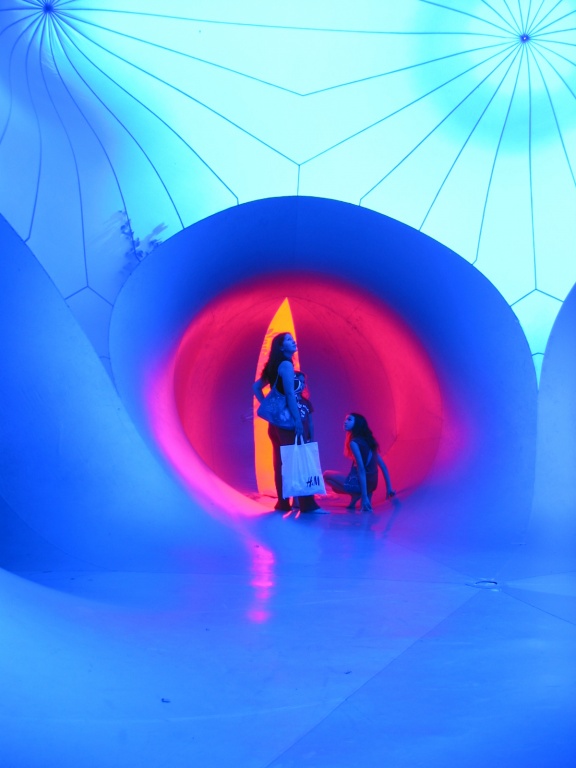
Visitors remove their shoes after passing through the airlock. They’re free to wander through the various labyrinthine tunnels washed in liquid color. Initially, they’re taken with the beauty of the light. Some sit and soak it up. Some sleep. Some listen to a musician who might be playing.
The experience is never the same, for it all depends on the changing light outside.
Now we come to you. What are your sacred spaces? Which is the one you remember the most?


