
What Your Brain Does (and Doesn’t) Perceive
Stephen Hawking offered up a great analogy in his newest book, The Grand Design. You start with a goldfish in a bowl and a person outside the bowl. The person walks in a straight line, but the goldfish, because of its perspective, sees the person walk in a curved line. Whose reality is correct? Well, hmmm, we’d have to admit that both perspectives are right. Goldfish could, if they were able to, formulate scientific laws governing the movement of objects outside their bowl, and they would be different from our own scientific laws.
That raises the question, of course: Is what we’re seeing only true for us? On a broader level, is our perception of the universe different from what it would be if we were on the opposite side of the Milky Way?
We might need some reminders about how our brain formulates data and experiences. Enter—the following website. It’s absolutely fascinating. I’ve never seen anything quite like it.
Called Mind Lab—produced by the Japan Science and Technology Agency—it’s a remarkable explanation of how our brain works (and how that affects our daily perceptions). Divided up into four “sessions,” each starting with a short 1-minute video, you’re given trials to see how well you fare (along with explanations of why you see what you do).
Session 1: Illusion of an uninterrupted world
Session 2: Constructing a 3-D world from 2-D images
Session 3: Visual interpretation of the physical world
Session 4: Perception beyond sensory input
So clear and easy to understand! I wish I could have used this with my high school biology students when I was teaching. It would have better clarified how our brain works—if anything, just to make us all aware. I kept thinking, “Wow, all of our perceptions could be brought into question!”
What do we believe about an important event in our life (that is false)? What do we believe about a person (that is false)? How are we wrong about our place in the universe? What aren’t we seeing? Have we based our life’s efforts on incorrect suppositions?
It’s something to contemplate, at least.
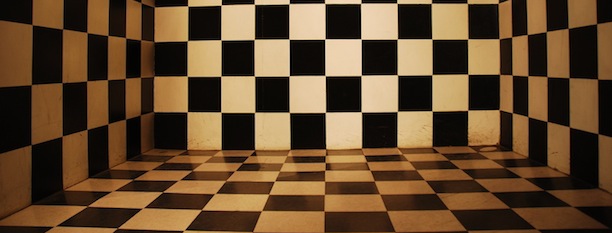
[Post image: Ames room illusion by Maddox on stock.xchng]


Don Rogers
Absolutely super!! Thanks for this. Even I can understand and appreciate what they’ve done here.
foszae
as a bit of a physicist myself, may i say that the goldfish analogy is pretty good. but there are two key facts which need more attention paid to them:
A) it is an illustration of the effects of gravitation. well, not exactly gravity, but a similar force of attraction which bends and warps our perceptions.
B) you do not define the relativistic nature of “correct”. if the person outside the bowl does not notice, but the goldfish does, the goldfish’s observation is closer to actual reality than that of the person walking by. who is correct is a matter of semantics (perception), but who is more scientifically accurate is pretty self-evident — the goldfish at least sees the phenomenon and recognizes there is a predictable pattern
Elissa
Yes, but we’re assuming both are cognizant of the matter. I, of course, wasn’t clear on that. So, if BOTH parties are knowledgeable of their “rules,” then we have a problem, right? 🙂